Ludwig van Beethoven’s Symphony No. 7 in A major, Op. 92, is a force of nature
Is Beethoven’s 7th Symphony an ancient musical monster that has thrilled and terrified audiences since 1813? On November 26, 2024, arranger and orchestrator Volker Wolfgang Schidlowski from germany, unleashed a bold new digital incarnation of this masterpiece under the SCHALLROLA label. This digital-only release (EAN: 4067248327937) brings the revolutionary fire of 1812 straight into the modern streaming era. Synthesizing the power of traditional orchestral writing with the precision of modern digital orchestration, this album offers a fascinating new way to experience a timeless classic—available to stream online for free, or to download for just a few euros.
In a digital landscape crowded with standard live recordings, Schidlowski’s version asks a compelling question: How do you breathe new life into a historical titan by using modern technology to forge a massive orchestral sound?
The Musical „Monster“ of 1813
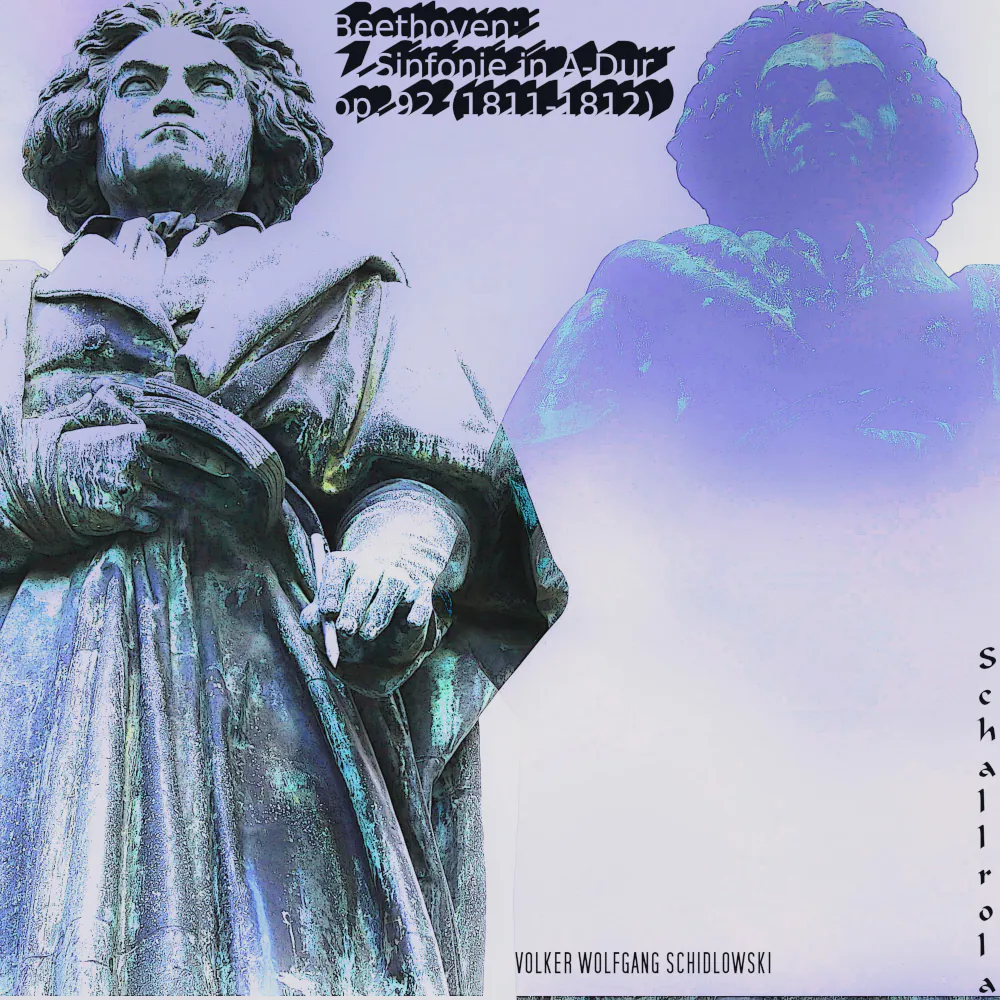
When Beethoven premiered the symphony in Vienna, listeners and critics were overwhelmed by its raw, relentless energy. The famous music professor Friedrich Wieck (Clara Schumann’s father) even claimed that the sheer ecstasy and wild rhythms of the Vivace and Allegro con brio movements proved Beethoven must have written it while drunk. The unbridled power of the orchestration—especially the screaming horns and driving rhythms—felt monstrously untamed to a public used to stricter classical elegance.
The Apotheosis of the Dance: Volker Wolfgang Schidlowski arranged Beethoven’s 7th Symphony
Ludwig van Beethoven’s Symphony No. 7 in A major, Op. 92 stands as one of the most energetic and exhilarating masterpieces in Western classical music history. On November 26, 2024, Volker Wolfgang Schidlowski released a compelling new recording of this monumental work under the SCHALLROLA label. This album (EAN: 4067248327937) captures the revolutionary fire that Beethoven poured into his manuscript between 1811 and 1812. With a total running time of just over 40 minutes and an accessible loudness, this digital release brings a timeless classic seamlessly into the modern streaming era.
In this blog post, we dive deep into the historical context of Beethoven’s masterpiece and analyze how Schidlowski interprets each of the symphony’s four contrasting movements.
Beethoven’s 7th Symphony: A Rhythmic Powerhouse
2.
When Beethoven composed his Seventh Symphony between 1811 and 1812, Europe was in complete political turmoil. The Napoleonic Wars were tearing the continent apart, and Beethoven himself was sinking into deep isolation due to his near-total deafness. Yet, instead of channeling despair, he crafted a work of pure, unbridled joy, vitality, and forward momentum.
Richard Wagner famously called the 7th Symphony the „Apotheose des Tanzes“ (The Apotheosis of the Dance). Unlike his previous symphonies, which often relied on heavy dramatic narratives or lyrical themes, the Seventh elevates rhythm to the ultimate driving force. It is a work built on hypnotic, repeating rhythmic cells that sweep listeners along from the very first bars.
Track-by-Track: The Four Movements Under the Microscope
Volker Wolfgang Schidlowski delivers a highly transparent and structurally focused reading of the score across four tracks.
1. Poco sostenuto – Vivace (Duration: 17:49)
The opening movement (ISRC: DE1JN2428675) is the epic anchor of the album, spanning nearly 18 minutes. Schidlowski handles the massive Poco sostenuto introduction with patient grandeur, allowing the harmonic shifts and ascending scales to build natural tension. When the Vivace finally erupts in a joyful 6/8 meter, the famous dotted rhythm takes center stage. Schidlowski’s precise balancing ensures that Beethoven’s crucial woodwind countermelodies slice cleanly through the dense string textures.
2. Allegretto (Duration: 04:39)
The Allegretto (ISRC: DE1JN2418170) is arguably one of the most famous pieces of music ever written. At its 1813 premiere in Vienna, the audience was so spellbound that they demanded an immediate encore of this movement. Schidlowski opts for a fluid yet somber tempo. The relentless, march-like dactylic rhythm (one long beat, two short) builds masterfully from the dark lower strings into a towering orchestral climax. Clocking in at a concise 4:39, this interpretation keeps the tension tightly wound and emotionally impactful.
3. Presto (Duration: 09:21)
The third movement (ISRC: DE1JN2417827) is an explosive, lightning-fast Scherzo. It bursts with dynamic surprises, sudden accents, and playful syncopations. Beethoven pushes the orchestra at a breakneck pace, contrasting it with a slower, hymn-like Trio section said to be based on an old pilgrims‘ chant. Schidlowski navigates these abrupt tempo shifts with sharp precision and crisp articulation.
4. Allegro con brio (Duration: 08:16)
The finale (ISRC: DE1JN2417977) is nothing short of a musical riot. Beethoven cranks the energy to maximum capacity, prompting some of his contemporary critics to declare that he must have been drunk when he wrote it. Schidlowski drives the orchestra fiercely through these final eight minutes. The swirling string lines and hammering brass accents culminate in a breathless, ecstatic finish that leaves the listener completely exhilarated.
Why This Release Stands Out
This SCHALLROLA production proves that high-quality classical music recordings can be highly transparent, fresh, and engaging. Volker Wolfgang Schidlowski approaches Beethoven with profound respect for the original score while utilizing his role as an orchestrator to bring a contemporary clarity to the soundstage. Every single voice in the score can be heard with absolute clarity because each part is performed by a single instrument. Instead of the bloated sound of massive ensembles or over-inflated symphony orchestras, this is a refined listening experience tailored for audiophiles—and the ultimate sonic food for high-quality headphones.
Whether you are experiencing Beethoven’s Seventh for the first time or have loved it for decades, this recording offers a gripping, rhythmic journey that honors the true spirit of the „Apotheosis of the Dance.“
So, to all the Beethoven purists out there sticking with their ear trumpets: relax! This isn’t a symphony struggle, it’s just great music. Put your headphones on, turn up the volume, and let this ancient monster roar forever.
7.